By Grant Grosgebauer, Mile High Legal · Last reviewed November 11, 2026
A T-bone crash happens in a fraction of a second, but the argument over who caused it can go on for months. Both drivers often believe they had the light or the right of way, and the side of a car offers little protection to the people sitting next to the door. This guide explains how Colorado’s right-of-way laws apply to intersection and T-bone crashes, what evidence settles the fault question, how shared fault changes what you can recover, and what to do in the first days after the crash.
What is a T-bone accident?
A T-bone accident, also called a broadside or side-impact collision, is a crash where the front of one vehicle hits the side of another, forming a “T.” They tend to happen where paths cross, such as intersections, driveways, and parking-lot exits: a driver turns left across oncoming traffic, rolls through a stop sign, or enters on a late yellow or red light and strikes a car crossing in front. Because the side of a vehicle has relatively little space to absorb crash energy, the Insurance Institute for Highway Safety (IIHS) notes that side impacts can be especially dangerous for occupants. In IIHS’s analysis of federal crash data, side impacts accounted for 22% of passenger-vehicle occupant deaths in the United States in 2024.
How common are T-bone and intersection crashes in Colorado?
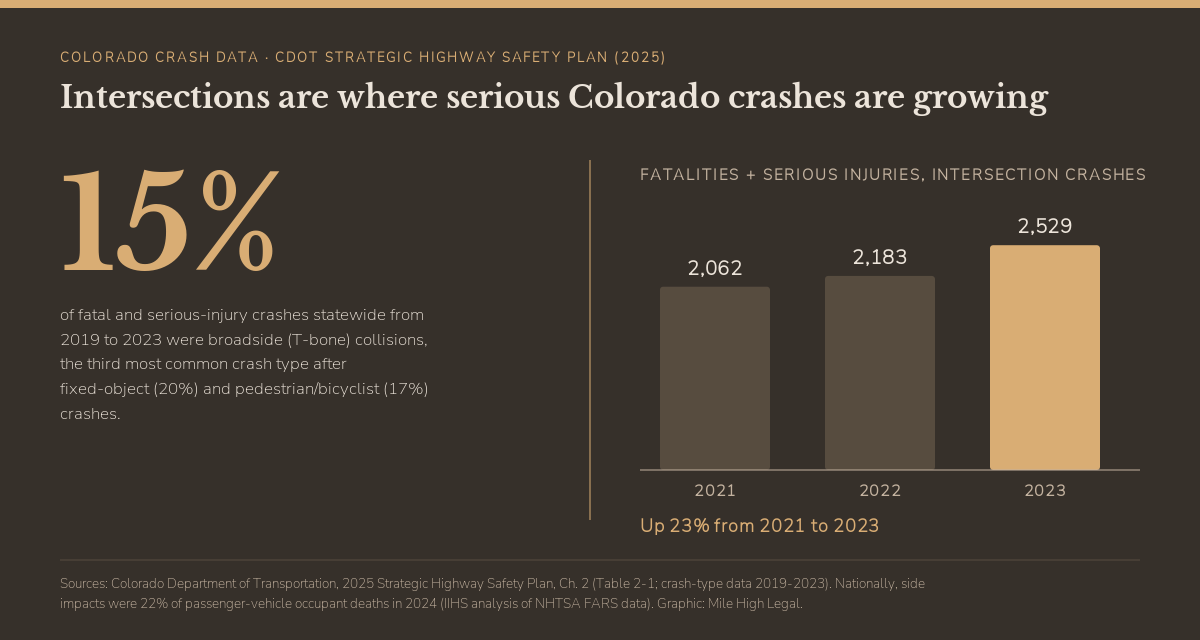
The Colorado Department of Transportation’s 2025 Strategic Highway Safety Plan lists intersections as a “High-Impact” focus area. According to CDOT, fatalities and serious injuries in intersection crashes rose from 2,062 in 2021 to 2,183 in 2022 and 2,529 in 2023, a 23% increase over that period. CDOT also reports that from 2019 to 2023, broadside collisions made up 15% of fatal and serious-injury crashes statewide, behind only fixed-object crashes (20%) and pedestrian and bicyclist crashes (17%). In urban areas, CDOT found that intersections were involved in 65% of fatal and serious-injury crashes from 2021 to 2023.
Who is at fault in a T-bone accident in Colorado?
At its core, fault comes down to one question: which driver had the duty to yield and failed to do it? Colorado’s traffic code sets out right-of-way rules for each kind of intersection, and the driver who breaks one of those rules is the natural starting point for fault. But no rule automatically decides a civil claim. A driver with the right of way can still share fault if they were speeding, distracted, or could have avoided a crash they saw coming. In a Colorado injury claim, fault is ultimately decided by an insurer in negotiation, or by a judge or jury, based on the evidence. The sections below walk through the rules that matter most in T-bone cases.
Who has the right of way when a driver turns left?
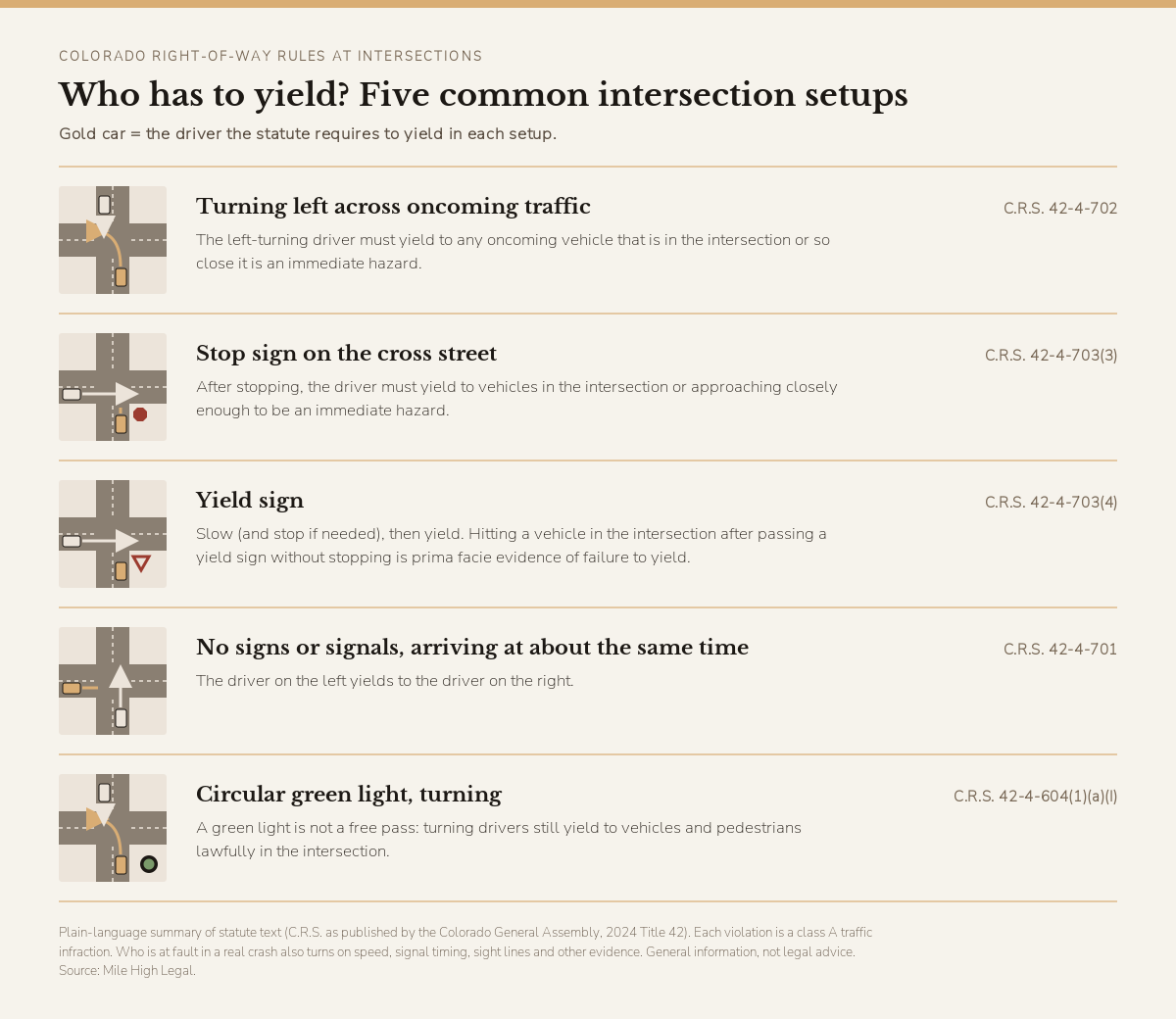
Under C.R.S. 42-4-702, a driver turning left at an intersection, or into an alley, private road, or driveway, “shall yield the right-of-way to any vehicle approaching from the opposite direction which is within the intersection or so close thereto as to constitute an immediate hazard.” That is why a left-turning driver who pulls into the path of an oncoming car is a natural focus of the fault analysis. The dispute then centers on “immediate hazard”: the turning driver may say the oncoming car was far away and speeding, which is a comparative-fault argument rather than a complete defense. Signal timing, speed evidence, and video often decide it. Read our short answer on left-turn intersection fault.
What about stop signs and yield signs?
At a stop sign, C.R.S. 42-4-703(3) requires the driver to stop and then yield to any vehicle in the intersection or “approaching on another roadway so closely as to constitute an immediate hazard.” Stopping is not enough; the driver also has to wait for a safe gap. Yield signs carry a rule that matters in T-bone cases: under C.R.S. 42-4-703(4), if a driver passes a yield sign without stopping and collides with a vehicle in the intersection, the collision is “prima facie evidence of the driver’s failure to yield right-of-way.” In practical terms, that shifts the burden onto the driver who went through the yield sign to explain the crash.
Who goes first at an intersection with no signs or signals?
When two vehicles approach or enter an uncontrolled intersection from different roads “at approximately the same time,” C.R.S. 42-4-701(1) says the driver on the left must yield to the driver on the right. The rule is modified at through highways and by the left-turn, stop-sign, yield-sign, and roadway-entry rules in sections 42-4-702 to 42-4-704. Whether the two cars really arrived “at approximately the same time” is often the contested point.
What if I had a green light?
A green light helps your claim, but it is not a blank check. Under C.R.S. 42-4-604(1)(a)(I), drivers facing a circular green may go straight or turn, but all traffic, “including vehicles turning right or left,” must yield to vehicles and pedestrians lawfully within the intersection. That rule cuts in both directions. A driver turning left on a solid green (no arrow) must still yield to oncoming traffic, and a driver who enters on a fresh green can still be partly at fault for striking a car that was lawfully clearing the intersection. A steady yellow, under 42-4-604(1)(b), is a warning that the green movement is ending and a red is coming.
What if both drivers say the light was green?
This is the classic T-bone dispute, and the answer is that independent evidence matters far more than either driver’s account. Useful evidence includes traffic-camera or nearby business video, dashcam footage, statements from witnesses who were not in either car, and the signal timing plan for the intersection, which shows how long each phase lasts. Vehicle damage and final resting positions help a reconstruction expert estimate speeds and angles, and some vehicles store event data (speed, braking, throttle) from the seconds before a crash. Video in particular can be overwritten quickly, so preservation requests need to go out early. See what evidence proves fault in a Colorado car accident.
Does a traffic ticket decide who was at fault?
Not by itself. A ticket for failing to yield is a strong signal of how the investigating officer saw the crash, and insurers pay attention to it. But C.R.S. 42-4-1713 provides that, except as provided in sections 42-2-201 to 42-2-208, “no record of the conviction of any person for any violation of this article shall be admissible as evidence in any court in any civil action.” In other words, the civil claim must be proven with evidence, not just with the outcome of the traffic case. The flip side is also true: if no ticket was written, or a ticket was dismissed, you may still prove the other driver was at fault. How a guilty plea or statements in the traffic case may be used is a separate question to discuss with a lawyer.
How does shared fault affect a T-bone settlement in Colorado?
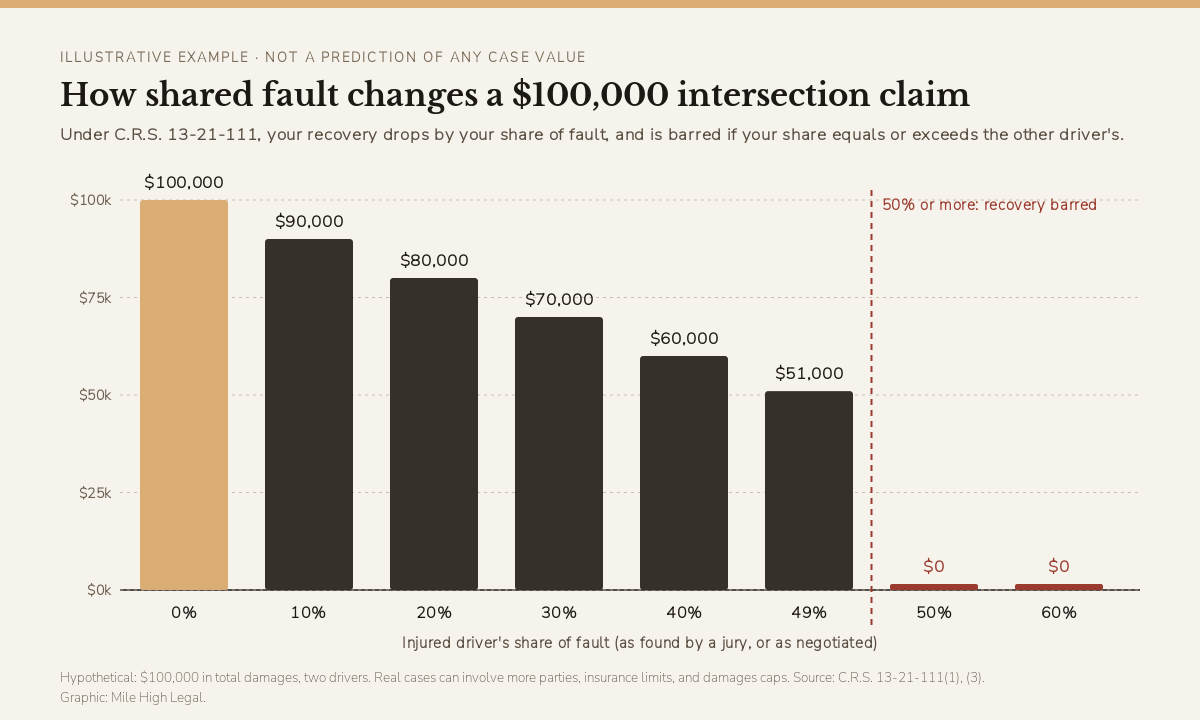
Colorado uses modified comparative negligence. Under C.R.S. 13-21-111, your own negligence does not bar recovery “if such negligence was not as great as” the negligence of the driver you are suing, but your damages are reduced in proportion to your share of fault. If your share is equal to or greater than the other driver’s, you recover nothing from that driver. In intersection crashes, insurers may argue that the driver with the right of way was speeding, looking at a phone, or should have braked sooner, because shifting even 10% or 20% of the fault lowers what they pay. See our full guide to comparative negligence in Colorado car accidents.
A worked example: how 30% of the fault changes the outcome
Here is a hypothetical. Dana is driving straight through an intersection on a green light when a driver turning left on a solid green cuts across her lane. Her car is struck on the front quarter and spun into a light pole. Her damages total $100,000: medical bills, lost wages, and pain and suffering.
- The insurer’s position: Dana was going 10 mph over the limit and could have stopped, so she is 30% at fault. Under 13-21-111, that would reduce her recovery to $70,000.
- The evidence: A nearby business camera shows the turning driver started the turn when Dana was only a few car lengths away, and the event data from Dana’s car shows she braked hard. If the fault split moves to 10%, her recovery becomes $90,000.
- The worst case: If a jury found Dana 50% or more at fault, she would recover nothing from the other driver.
Even then, the at-fault driver’s insurance limits matter. Colorado’s minimum liability coverage is $25,000 per person and $50,000 per accident (C.R.S. 42-7-103), so a serious T-bone injury can exceed the other driver’s policy. Your own uninsured/underinsured motorist coverage may fill the gap.
What injuries can a T-bone crash cause?
Because the occupant on the struck side sits close to the door, side impacts can cause injuries to the head, chest, pelvis, and hips, along with neck injuries from the sideways whip of the head. Depending on the crash, people may experience concussions and traumatic brain injuries, rib fractures, shoulder and pelvic fractures, spinal cord injuries, and whiplash and other neck or back injuries. Some symptoms, especially from brain injuries and soft-tissue injuries, may not appear right away. That is one reason to get a medical evaluation promptly after any side-impact crash, even if you feel fine, and to tell every provider exactly how the crash happened and which side of the car was hit.
What should I do after a T-bone accident in Colorado?
If you are able, these steps protect both your health and your claim:
- Call 911 and get medical care. Your health comes first, and prompt records connect your injuries to the crash.
- Photograph the scene: both vehicles, the point of impact, skid marks, debris, signal heads, stop or yield signs, and any obstructed sight lines.
- Note every camera you can see: traffic cameras, gas stations, storefronts, and doorbell cameras near the intersection.
- Get witness names and phone numbers, especially people who were not in either car. A neutral witness to the light color can be the most valuable evidence in the case.
- Write down what you remember about the light, your speed, and the other car’s movement while it is fresh.
- Get the crash report number and the investigating agency’s name.
- Avoid recorded statements to the other driver’s insurer until you have talked with a lawyer, and don’t guess about speeds or distances.
- Keep the vehicle available for inspection before it is repaired or salvaged, if you can; its damage and stored data may matter. You may also have a diminished value claim.
What if the other driver ran a red light while drunk or fled the scene?
Some T-bone crashes involve a driver who was impaired or who left without stopping. Those facts can change the claim. A DUI case may produce evidence that helps your civil claim, and Colorado law may allow additional damages in some impaired-driving cases; see hit by a drunk driver in Colorado. If the driver fled and is never identified, your uninsured motorist coverage may apply. Report the crash to police right away in either situation.
What if a city bus, government vehicle, or bad intersection design was involved?
Claims involving a government driver or a public entity follow different rules. Under the Colorado Governmental Immunity Act, written notice of the claim must generally be given within 182 days of discovering the injury (C.R.S. 24-10-109). That notice deadline is separate from, and earlier than, the deadline to file a lawsuit. Claims that a signal was malfunctioning or that an intersection was dangerously designed raise their own immunity questions and should be reviewed quickly. See our guide to RTD and bus accident claims.
How long do I have to file a T-bone accident claim in Colorado?
For a car accident injury claim against a private driver, Colorado generally allows three years from when the claim accrues to file a lawsuit (C.R.S. 13-80-101(1)(n)). Different and shorter deadlines can apply in other situations, including the 182-day notice for claims against government entities. Waiting is risky for a more practical reason, too: in intersection cases, video is often overwritten within days or weeks, and witnesses become harder to find. See Colorado’s car accident statute of limitations.
How much is a T-bone accident claim worth?
There is no standard value, and “average settlement” figures you see online deserve skepticism. The value of a T-bone claim depends on the medical treatment you need now and in the future, lost income, how the injuries affect your daily life, how clearly the evidence shows fault, any comparative-fault reduction, and the insurance available. Noneconomic damages such as pain and suffering are subject to a statutory cap in Colorado, while damages for physical impairment or disfigurement are treated differently; see pain and suffering damages in Colorado. If your health insurance paid for treatment, it may seek repayment from the settlement; see health insurance liens.
Hurt in a T-bone or intersection crash in Colorado?
Intersection cases often turn on evidence that disappears quickly: a few seconds of video, a witness who saw the light, and data stored in the vehicles. Mile High Legal represents people injured in car crashes across Colorado, and we can help you preserve that evidence and push back when an insurer tries to shift the blame onto you. Contact us to talk about your case, or read more about Colorado car accident claims.
Data sources: Colorado Department of Transportation, 2025 Strategic Highway Safety Plan, Chapter 2; Insurance Institute for Highway Safety, Fatality Facts 2024: Passenger vehicle occupants. Statutes quoted from the Colorado Revised Statutes as published by the Colorado General Assembly.
This page is general information, not legal or medical advice, and does not create an attorney-client relationship. Past results do not guarantee future outcomes.