By Grant Grosgebauer, Mile High Legal · Last reviewed: November 1, 2026
Most people I talk to after a Colorado car crash can tell me, to the dollar, what their ER visit cost. What they can’t put a number on is the part that actually changed their life: the months of not sleeping through the night, the physical therapy that hurt more than the injury, the hike they used to do every Saturday and now can’t, the way they flinch at every intersection on Colfax. That’s pain and suffering. It’s often the largest piece of an injury claim, and it’s the piece insurance companies work hardest to shrink, because there’s no receipt for it.
This guide explains how pain and suffering damages actually work in Colorado: what they cover, how lawyers and insurers put a value on them, how the state’s damages cap changed for cases filed in 2025 and later, and what you can do starting today to make sure your suffering is taken seriously.
What Counts as “Pain and Suffering” in a Colorado Injury Claim?
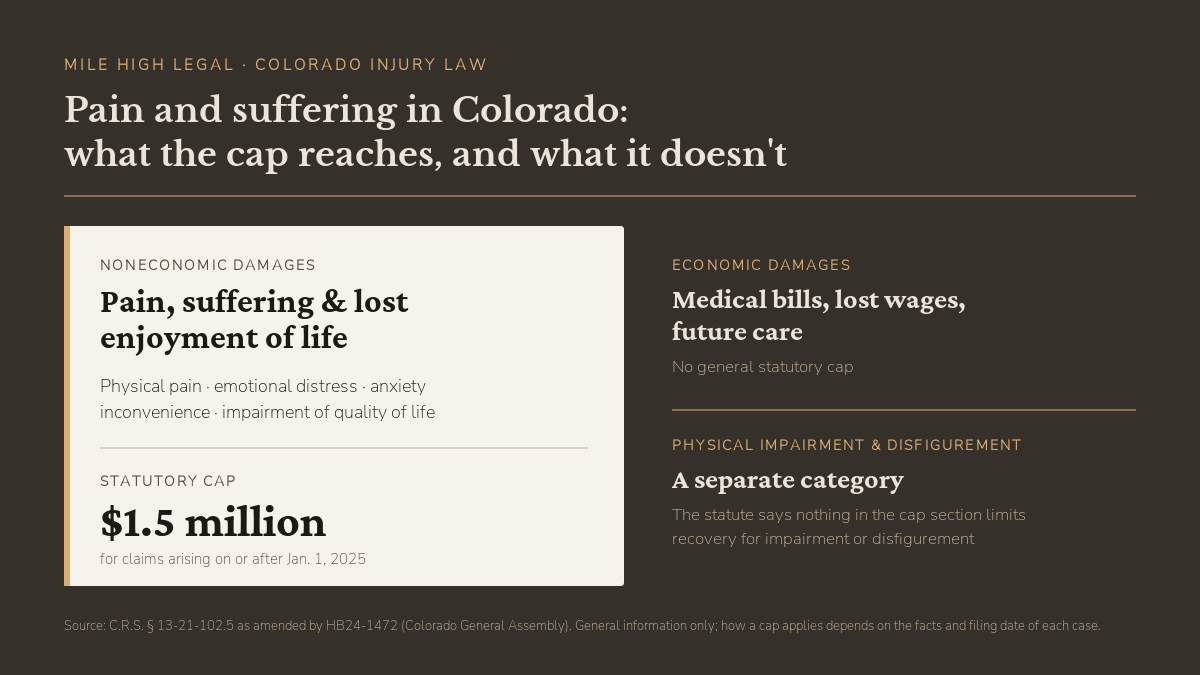
In Colorado, “pain and suffering” is shorthand for noneconomic damages: losses that are real but don’t come with a bill. Colorado’s damages statute defines noneconomic loss as “nonpecuniary harm” suffered by the injured person, “including pain and suffering, inconvenience, emotional stress, and impairment of the quality of life” (C.R.S. § 13-21-102.5(2)(b)). In practice, that covers physical pain during and after treatment, anxiety or post-traumatic stress after the crash, sleep loss, the frustration of depending on others for basic tasks, and the loss of activities that made your life yours. These damages are separate from economic damages (medical bills, lost wages, future care costs), which are proven with records and receipts. Both are recoverable in the same claim, but they’re valued and limited differently.
Is physical impairment or disfigurement treated differently?
Yes, and this distinction matters in serious injury cases. Colorado juries can award damages for physical impairment and disfigurement as their own category, separate from general pain and suffering. The damages-cap statute says plainly that nothing in it “shall be construed to limit the recovery of compensatory damages for physical impairment or disfigurement” (C.R.S. § 13-21-102.5(5)), and HB24-1472 left that subsection untouched. For someone left with a permanent limp, nerve damage, a visible scar, or reduced range of motion, how that harm is categorized and proven can significantly change what a case is worth, especially when the noneconomic cap is in play.
How Is Pain and Suffering Calculated in Colorado?
Colorado law does not contain a formula for pain and suffering. A jury decides what amount fairly compensates you based on the evidence, and in settlement negotiations, both sides are predicting what a jury would do. To make that prediction, insurers and lawyers lean on two rough conventions. The multiplier method takes your economic losses and multiplies them by a number, often somewhere between 1.5 and 5, based on how severe and lasting the injury is. The per diem method assigns a daily dollar value to your suffering and multiplies it by the number of days you were affected. Neither is binding on anyone. They’re negotiation tools, and an adjuster will pick whichever one produces the lower number for your file.
What makes the number go up or down?
The factors that move a pain and suffering valuation are consistent from case to case: how severe the injury is and whether it’s permanent; how long treatment lasted and how invasive it was (surgery and injections carry more weight than chiropractic visits alone); whether the injury is documented consistently in medical records; how much it disrupted your work, family, and daily routine; whether there are gaps in treatment an insurer can point to; how clearly the other driver was at fault; and how credible and specific you are when you describe what you’ve been through. Two people with the same diagnosis can end up with very different numbers depending mostly on documentation.
A Worked Example: Same Injury, Three Different Numbers
Here’s a simplified, hypothetical example (not a prediction of what any case is worth) to show how the methods and Colorado’s fault rules interact.
Say you were hit at an intersection and suffered a herniated disc. You have $31,000 in medical bills and $11,000 in lost wages, for $42,000 in economic losses. You were in active treatment and significant pain for about nine months (270 days).
- Per diem approach: At $200 per day for 270 days, pain and suffering is valued at $54,000. Total claim: $42,000 + $54,000 = $96,000.
- Multiplier approach: Using a 3x multiplier on economic losses, pain and suffering is valued at $126,000. Total claim: $42,000 + $126,000 = $168,000.
- Shared fault: Now the insurer argues you were 20% at fault for entering the intersection on a stale yellow. Under Colorado’s modified comparative negligence rule, your recovery is reduced by your share of fault: $168,000 × 0.80 = $134,400 (C.R.S. § 13-21-111(1), (3)).
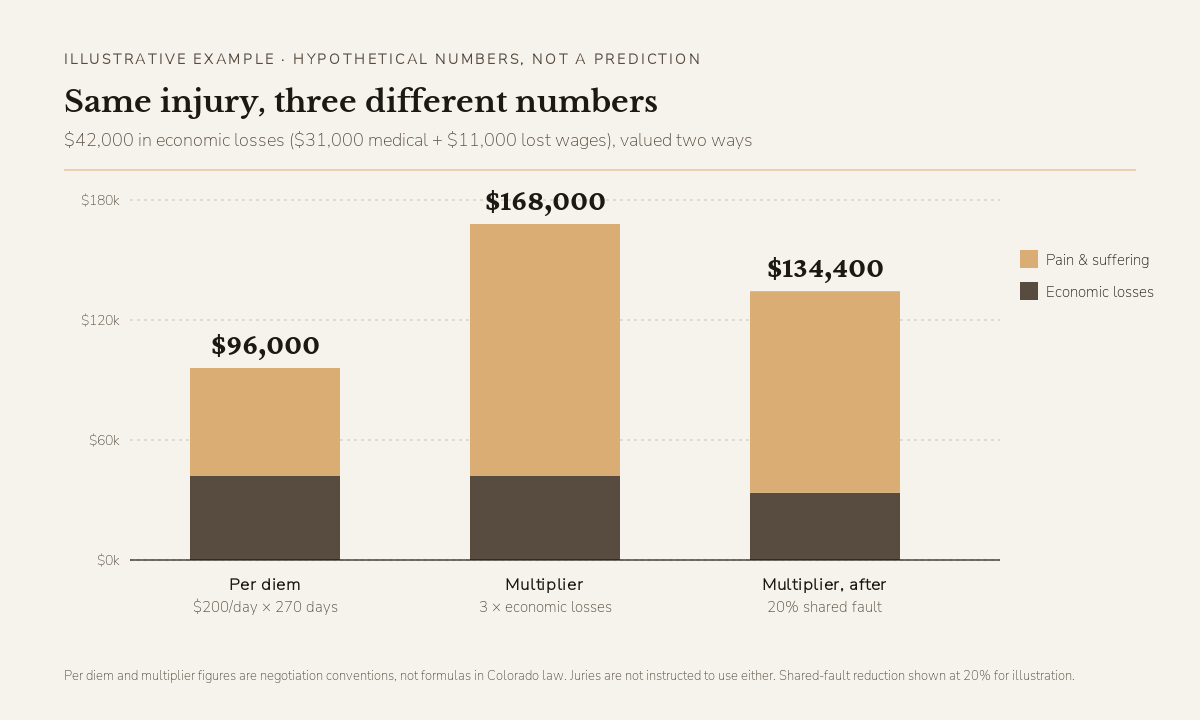
Same injury, a $72,000 spread between the first two numbers, and a five-figure swing from a single fault argument. That’s why the documentation and the fault evidence matter as much as the injury itself. For more on how fault percentages get assigned and challenged, see our guide to Colorado comparative negligence.
Is There a Cap on Pain and Suffering Damages in Colorado?
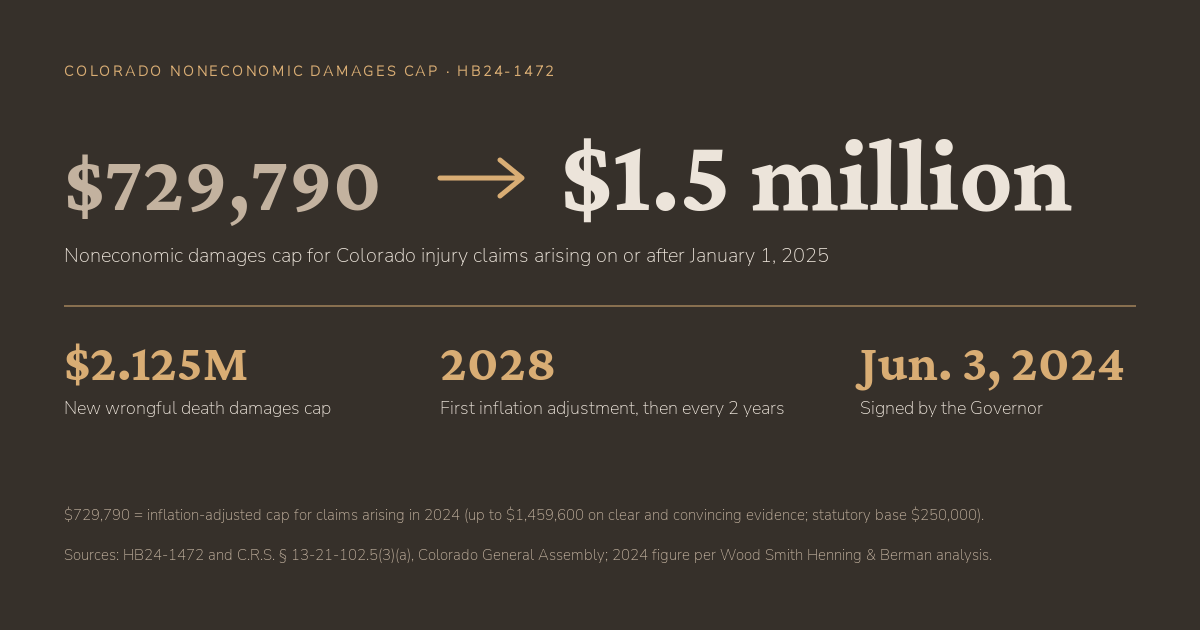
Yes. Colorado caps noneconomic damages in most personal injury cases, and that cap changed significantly in 2025. Under HB24-1472, signed by the Governor on June 3, 2024, the cap is $1.5 million for claims arising on or after January 1, 2025 (C.R.S. § 13-21-102.5(3)(a)(II)). The new cap is a single, firm ceiling: the old rule that let a judge go above the standard cap on “clear and convincing evidence” does not apply to it. Starting January 1, 2028, and every two years after that, the cap adjusts for Denver-area inflation. Wrongful death claims have their own, separate cap of $2.125 million (C.R.S. § 13-21-203).
What was the cap before 2025?
The statute’s base figure was $250,000, but it had been adjusted for inflation over the years. For claims arising in 2024, the adjusted cap was $729,790, and a judge could raise it to as much as $1,459,600 if the injured person showed justification by clear and convincing evidence. HB24-1472 roughly doubled the standard cap and replaced that two-tier system with one $1.5 million limit.
Does the cap affect most car accident claims?
Usually not directly. Most car accident claims settle for well under $1.5 million in noneconomic damages, so the cap never comes into play. Where it matters is catastrophic injury, such as a traumatic brain injury, spinal cord damage, or amputation, where a jury could value a lifetime of suffering above the limit. In those cases, the way a lawyer separates and proves physical impairment, disfigurement, and future economic losses can determine how much of the award survives. The cap is also different in medical malpractice cases, which follow their own schedule.
How Do Insurance Companies Value Pain and Suffering?
From the other side of the table, pain and suffering looks like a negotiable line item. Some large auto insurers use claims-evaluation software that scores bodily injury claims from what’s in the medical file, and that output can strongly influence the first offer. In 2010, Allstate paid $10 million in a settlement with 45 states after a multistate regulatory examination of how it used one such program, Colossus, to guide bodily injury settlements (Insurance Journal). What that means in practice: if something isn’t written in your medical records, it often doesn’t exist to the adjuster. Telling your doctor “it’s fine” at a follow-up, skipping appointments, or waiting three weeks to see anyone after the crash all show up as lower numbers. Adjusters also look hard at social media. A photo of you smiling at a birthday party can be framed as proof you weren’t really hurting, even if you spent the next two days in bed.
How Do You Prove Pain and Suffering in Colorado?
You prove pain and suffering the way you’d prove anything else: with consistent, specific evidence from more than one source. Medical records carry the most weight, especially records that describe pain levels, functional limits, and how symptoms changed over time. Your own testimony matters, but it’s far more persuasive when it’s backed by a contemporaneous record and by people who knew you before the crash and can describe the difference. In serious cases, treating physicians, pain specialists, or mental health providers may testify about prognosis and the likely long-term effects. The goal is to give a jury or adjuster a clear before-and-after picture.
Evidence checklist: what to start keeping now
- A pain journal. Short daily entries: pain level, what you couldn’t do, sleep, medications, missed events. Dated, honest, and specific beats dramatic.
- Every medical record and bill, including physical therapy, imaging, prescriptions, and mileage to appointments.
- Consistent treatment. Go to your appointments and follow the treatment plan. Gaps are the first thing an insurer will use against you.
- Honest reporting to your doctors. Describe what you actually can’t do. “I can’t lift my daughter” is more useful in a record than “a little sore.”
- Photos and video of visible injuries, braces, casts, and scarring over time.
- Witnesses to the change: a spouse, coworker, coach, or friend who can describe what you did before the crash and what you can’t do now.
- Work records showing missed time, light duty, or lost opportunities.
- Mental health treatment records if you’re dealing with anxiety, depression, or PTSD after the crash.
- A quiet social media presence. Pause posting until your claim resolves.
Does Being Partly at Fault Reduce Pain and Suffering Damages?
Yes. In Colorado, your share of fault reduces your total recovery, including pain and suffering, by the same percentage. If a jury values your noneconomic damages at $200,000 and finds you 25% at fault, that portion of your recovery drops to $150,000. Under Colorado’s comparative negligence statute, if your share of fault is equal to or greater than the other driver’s, which in a two-driver crash means 50% or more, the court enters judgment for the defendant and you recover nothing (C.R.S. § 13-21-111(3)). This is why insurers so often assign some fault to the injured driver even in seemingly clear cases: every percentage point comes straight off the pain and suffering number. Pushing back with crash reports, photos, witness statements, vehicle data, and, when needed, accident reconstruction is often worth more than arguing about the multiplier.
How Long Do You Have to File a Pain and Suffering Claim in Colorado?
For most Colorado car accident injury claims, the deadline to file a lawsuit is three years from the date of the crash, which is longer than the two-year deadline that applies to most other injury claims (C.R.S. § 13-80-101(1)(n)(I); compare § 13-80-102(1)(a)). Claims against a city, county, or state agency, such as a crash with a government-owned vehicle, are different: the Colorado Governmental Immunity Act requires formal written notice within 182 days after you discover the injury, and missing that deadline can bar the claim entirely (C.R.S. § 24-10-109(1)). Waiting until the deadline is close is risky for a less obvious reason, too: evidence of pain and suffering is strongest when it’s gathered while you’re living through it. See our guide to the Colorado car accident statute of limitations for more.
Is a Pain and Suffering Settlement Taxable?
Generally, no. Under federal law, damages received on account of personal physical injuries or physical sickness, including the pain, suffering, and emotional distress that flow from a physical injury, are excluded from taxable income (26 U.S.C. § 104(a)(2); IRS Publication 4345). Punitive damages, interest, and emotional distress damages that aren’t tied to a physical injury can be taxable, so it’s worth confirming the details with a tax professional before you settle. We cover this in more detail in Are personal injury settlements taxable?
Should You Accept the First Offer for Pain and Suffering?
Usually not, and especially not early. First offers often come before you’ve finished treatment, which means the insurer is valuing your suffering before anyone, including you, knows how long it will last or whether it’s permanent. Once you sign a release, you can’t reopen the claim if your back gets worse or you need surgery next year. The better move is to finish treatment or reach what doctors call maximum medical improvement, gather the full picture, and then negotiate from evidence. If an adjuster pressures you for a quick recorded statement or a fast signature, that pressure is itself a reason to talk to a lawyer first.
When Should You Talk to a Colorado Injury Lawyer About Pain and Suffering?
If your injuries required more than a single doctor’s visit, if you’re still in pain weeks after the crash, if the insurer is blaming you for part of the collision, or if you’ve received an offer that doesn’t reflect what you’ve lived through, it’s worth a conversation. Pain and suffering is the part of a claim that depends most on how it’s presented, and it’s the part people most often leave on the table when they handle a claim alone. You can learn more about how our team handles these cases on our Colorado car accident and catastrophic injury pages.
Talk to Mile High Legal About Your Claim
You shouldn’t have to prove your pain to an adjuster whose job is to discount it. At Mile High Legal, we handle Colorado car accident and injury claims on contingency: you pay nothing upfront, and nothing at all unless we recover money for you. Call (720) 853-5779 or contact us online for a free, confidential consultation.
This article is general information about Colorado law, not legal advice for your situation. Every case depends on its own facts, and past results do not guarantee a similar outcome. Reading this article does not create an attorney-client relationship.