Last reviewed: October 22, 2026
A rear-end collision on I-25, a fall on an icy sidewalk in LoDo, a motorcycle crash on US-6 — the force doesn’t have to be dramatic for a brain injury to follow. Many traumatic brain injuries (TBIs) never show up on a CT scan, and victims often walk away from the scene insisting they’re fine, only to develop headaches, memory gaps, or mood changes days later. That gap between “I feel okay” and “something is wrong” is exactly where insurance companies build their defense. This article walks through what a TBI claim actually looks like in Colorado: how injuries are classified, what they’re worth, how long you have to file, and what evidence makes the difference between a denied claim and a fair settlement.
What Counts as a Traumatic Brain Injury in Colorado?
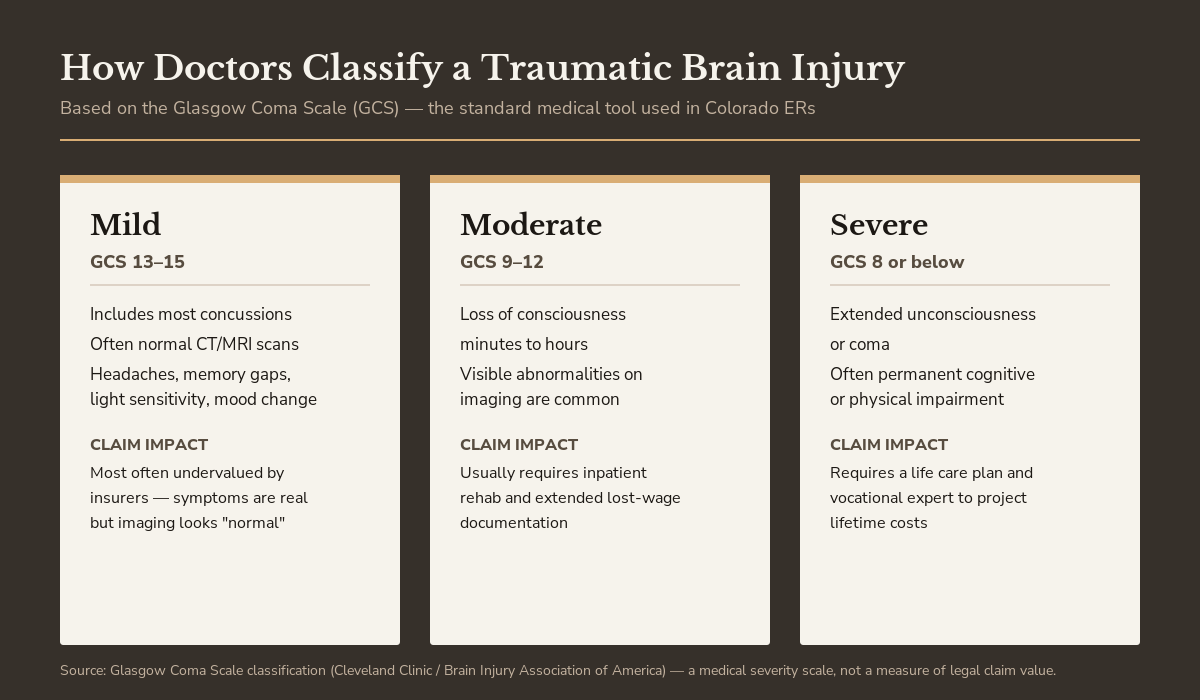
A traumatic brain injury is any disruption of normal brain function caused by a blow, jolt, or penetrating injury to the head. Doctors classify TBIs as mild, moderate, or severe using the Glasgow Coma Scale (GCS), which scores a patient’s eye, verbal, and motor responses from 3 to 15. A GCS of 13–15 is classified as mild (this includes most concussions), 9–12 as moderate, and 8 or below as severe. “Mild” is a medical label, not a legal one — a mild TBI can still cause permanent cognitive, emotional, and physical symptoms that affect a person’s ability to work and function for years.
How Common Are Brain Injuries After Colorado Accidents?
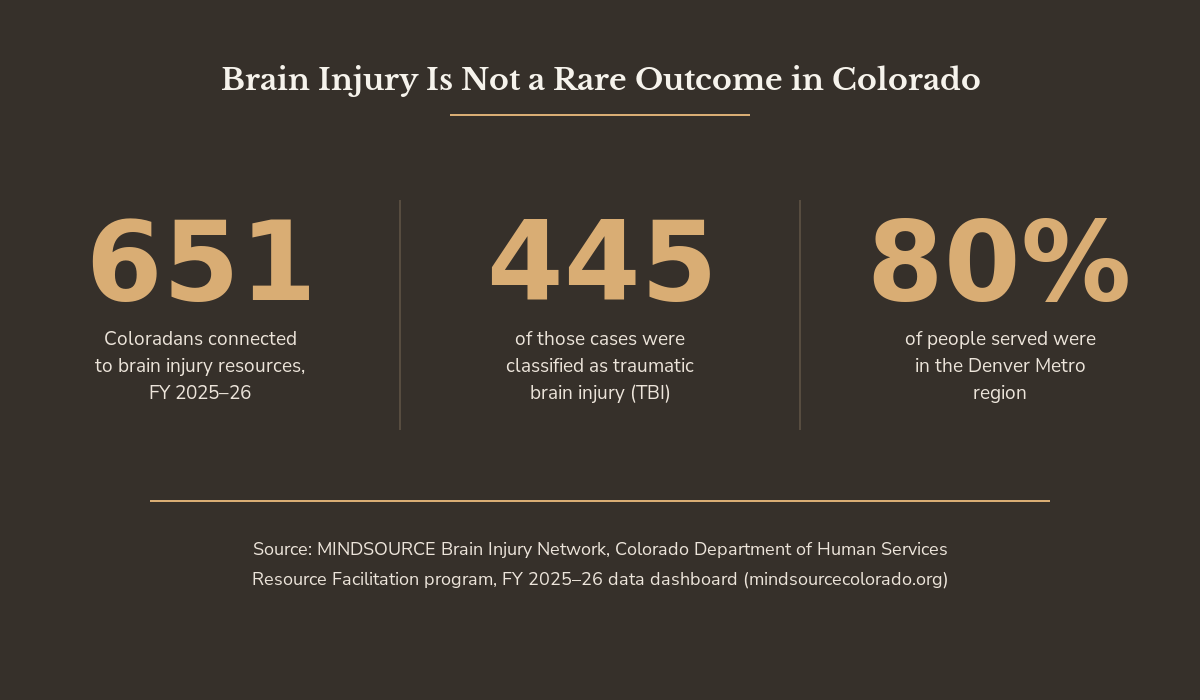
Brain injuries are not a rare outcome of Colorado crashes. According to MINDSOURCE Brain Injury Network, the state’s dedicated brain injury program under the Colorado Department of Human Services, its contracted resource facilitation program served 651 Coloradans in the 2025–26 fiscal year — and 445 of those cases were classified as TBI, with another 195 classified as “both” TBI and another injury type. That means roughly 98% of the people the state’s own brain injury program helped that year were dealing with some degree of traumatic brain injury. Denver Metro accounted for 523 of the 651 people served, or about 80% of the program’s reach statewide. Separately, CDOT’s preliminary data counted 701 roadway deaths across Colorado in 2025, and serious crashes — even ones that don’t involve a fatality — are a leading cause of the head trauma MINDSOURCE’s numbers reflect.
What Types of Colorado Accidents Most Often Cause Traumatic Brain Injuries?
Any accident involving a sudden jolt, impact, or fall can cause a TBI, but a few categories show up again and again in Colorado injury claims. Rear-end and T-bone car accidents are the most common cause, since the head can strike a window, headrest, or steering wheel even in crashes that leave relatively little vehicle damage. Truck accidents on corridors like I-70 and I-25 tend to produce more severe TBIs because of the size and speed differential involved. Motorcyclists face an outsized risk — even with a helmet, the brain can still suffer a concussive injury from rotational force alone — and slip-and-fall accidents on ice, wet floors, or poorly maintained stairs are a leading cause of head injuries among older Coloradans. Pedestrians and cyclists struck by vehicles face some of the highest TBI severity rates of any accident type, given the near-total lack of protection at the moment of impact.
What Is My TBI Claim Actually Worth?
There’s no fixed formula or online calculator that can tell you what a Colorado TBI claim is worth, and any site that promises one is guessing. What a claim is actually worth depends on the severity of the injury, the quality of the medical documentation, and how clearly the injury connects to the crash. That said, the damages fall into two buckets, and walking through a simplified example shows how they interact.
Economic damages: the costs you can add up
Economic damages are the calculable costs: emergency care, imaging, neurological follow-up, rehabilitation, lost wages during recovery, and — for moderate to severe TBIs — the projected cost of future care if the injury causes lasting impairment. For a moderate TBI requiring inpatient rehab, these costs commonly run into six figures once lost earning capacity is included.
Non-economic damages: pain, suffering, and loss of a normal life
Non-economic damages compensate for what a spreadsheet can’t capture — chronic headaches, personality changes, the loss of ability to parent, work, or enjoy hobbies the way you did before the crash. Colorado law allows juries to award these damages, though statutory caps apply to certain claims and the caps adjust periodically.
Worked example: how shared fault changes the number
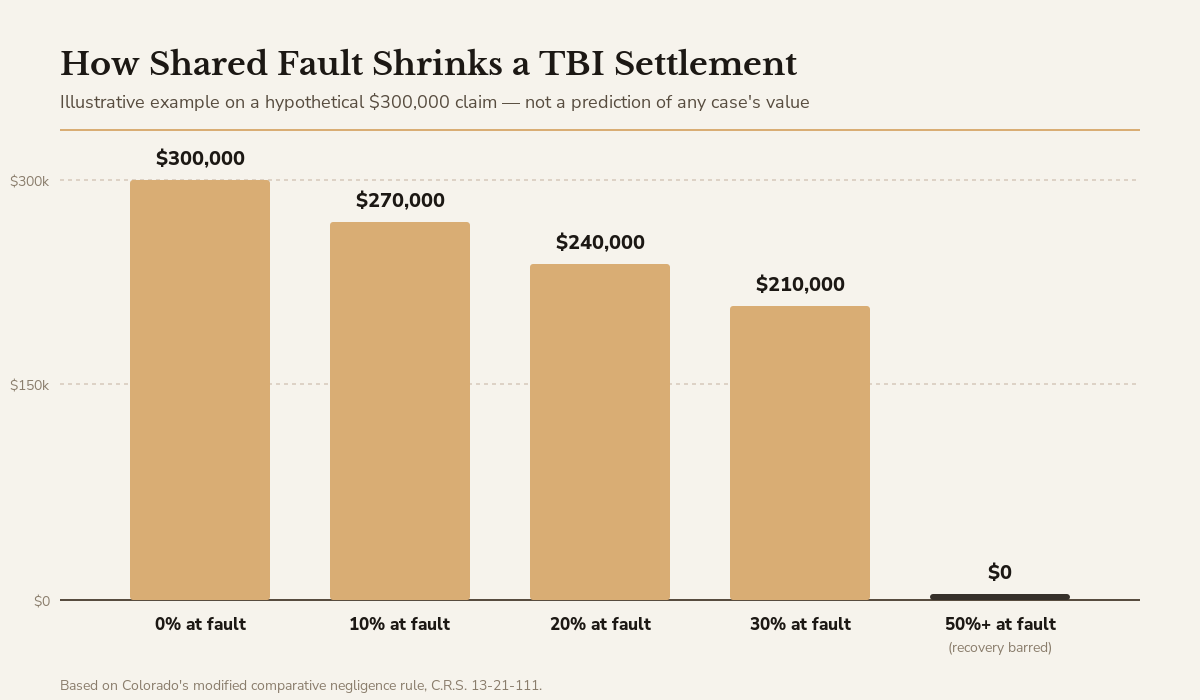
Say a claim’s full value — economic and non-economic damages combined — is calculated at $300,000. If the insurance company argues you were 20% at fault for the crash (say, for following slightly too close), Colorado’s modified comparative negligence rule reduces your recovery by that percentage: $300,000 minus 20%, or $60,000, leaves a net recovery of $240,000. If your share of fault is found to be 50% or more, Colorado law bars you from recovering anything at all. That’s why insurers for TBI claims frequently push hard on the fault allocation — shaving even 10–15 percentage points off a six-figure claim is real money to them. (For a full breakdown of how comparative negligence works in Colorado, see our comparative negligence guide.)
How Long Do I Have to File a TBI Claim in Colorado?
Colorado’s general personal injury statute of limitations is two years from the date of injury under C.R.S. 13-80-102, but claims arising from a motor vehicle accident typically get three years under C.R.S. 13-80-101. Because TBI symptoms can take days or weeks to fully surface, and insurance negotiations can take months, the practical message is simple: don’t wait to find out which deadline applies to you.
What Evidence Proves a Traumatic Brain Injury Claim?
Because many TBIs don’t show up on a CT scan or X-ray, the strength of your claim often comes down to the quality and consistency of documentation. A well-supported TBI claim typically includes:
- Emergency room or urgent care records from the day of the crash, even if symptoms seemed minor at the time
- A neurological evaluation, ideally including cognitive testing (not just imaging)
- A written symptom diary logging headaches, memory lapses, mood changes, and sleep disruption from day one
- Statements from family, friends, or coworkers who’ve noticed changes in behavior, memory, or personality since the crash
- Employment records showing missed work, reduced hours, or a change in job duties
- Follow-up care records — gaps in treatment are one of the first things insurance adjusters use to argue the injury wasn’t serious
Why Insurance Companies Undervalue Mild TBIs and Concussions
Adjusters are trained to treat “mild TBI” as a reassuring label and “concussion” as a short-term inconvenience that resolves in days. That framing ignores the medical reality: a meaningful share of concussion patients experience post-concussion syndrome, with symptoms lasting weeks or months. Insurers frequently point to a normal CT scan as proof there’s “nothing wrong,” even though standard imaging isn’t designed to detect the microscopic axonal damage that causes most mild TBI symptoms. Without consistent documentation and a clear medical narrative connecting the crash to your ongoing symptoms, a legitimate brain injury claim can get quietly reclassified as a routine soft-tissue claim — and settled for a fraction of its value.
Can I Still Recover Damages If I Had a Prior Head Injury or Concussion?
Yes. Colorado follows what’s often called the “eggshell plaintiff” rule: the person who caused the crash takes the victim as they find them, including any pre-existing vulnerability. If an old concussion made your brain more susceptible to a new injury, that doesn’t reduce your right to recover — it just means your medical team needs to clearly document which symptoms are new or worsened, so the claim isn’t dismissed as “pre-existing.” Insurers raise prior head injuries specifically because they know most claimants aren’t aware of this rule, and they’ll use any medical history gap to argue your current symptoms aren’t related to the crash at all.
What Happens If the Brain Injury Is Severe or Permanent?
Moderate and severe TBIs change the entire scope of a claim. Beyond medical bills and lost wages, a severe TBI case typically requires a life care planner — a medical professional who projects the cost of a lifetime of care, including attendant care, adaptive equipment, home modifications, and ongoing therapy. These cases also frequently involve a vocational expert to establish lost future earning capacity, since a severe TBI can end a career entirely rather than just interrupting it for a few months. Because the stakes are so much higher, insurers typically assign their most experienced adjusters and defense counsel to severe TBI claims early, which is exactly why having your own experienced representation from the start matters just as much.
What Should I Do After a Suspected Brain Injury in a Colorado Accident?
- Get evaluated the same day if possible, even if you feel “fine” — symptoms often appear later
- Follow every referral, including neurology, cognitive therapy, or concussion specialists, and keep every appointment
- Start a daily symptom log immediately — headaches, confusion, sensitivity to light, mood swings, sleep problems
- Avoid giving a recorded statement to the at-fault driver’s insurance company before speaking with an attorney
- Photograph the scene, vehicle damage, and any visible injuries before evidence disappears
- Talk to a Colorado personal injury attorney before accepting any settlement offer, since early offers are typically calculated before the full extent of a brain injury is known
If you or someone you love is dealing with headaches, memory problems, or personality changes after a Colorado crash, don’t assume it will resolve on its own and don’t negotiate with an insurance adjuster alone. Contact Mile High Legal for a free, no-obligation consultation — we’ll help you understand what your claim is actually worth and make sure the full scope of your injury gets documented before the insurance company has a chance to minimize it.