By Grant Grosgebauer, Mile High Legal · Last reviewed: November 7, 2026
When someone tells me they were hit by a drunk driver, there’s usually a particular kind of anger underneath the pain. It wasn’t black ice or a moment of bad luck. Someone made a choice to drive impaired, and you’re the one paying for it: in the ER, at physical therapy, on the phone with an adjuster who seems to think the whole thing is routine. It isn’t routine, and Colorado law doesn’t treat it that way either.
Our firm handles both sides of these crashes. We defend people charged with DUI, so we know exactly how impaired-driving cases are built, where the evidence lives, and how the criminal case moves. We also represent injured people. This guide puts both perspectives together: what happens to the drunk driver’s criminal case, what you can recover in your own injury claim, when Colorado allows extra “exemplary” damages, and what to do in the weeks after the crash.
How Common Are Drunk Driving Crashes in Colorado?
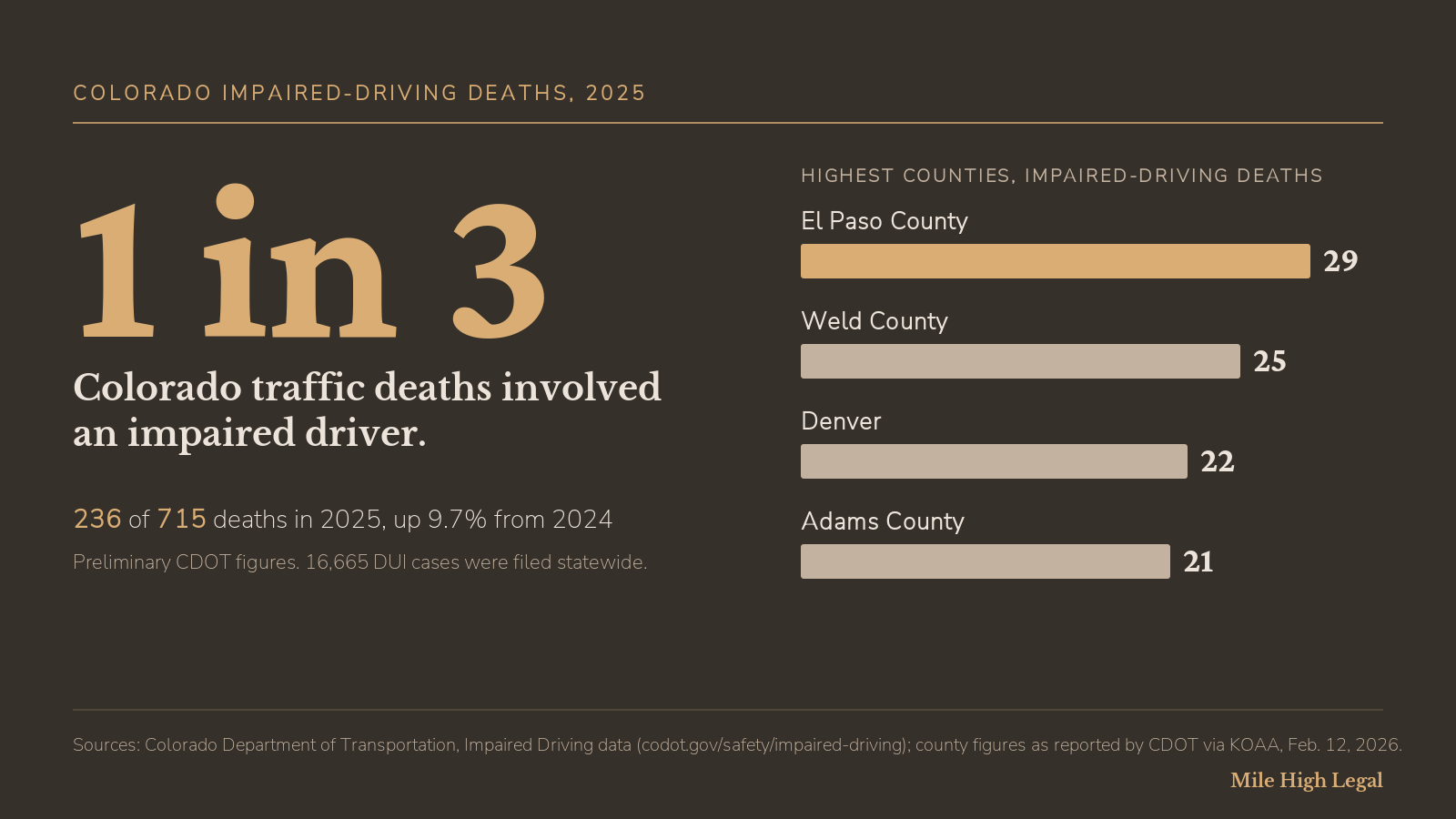
More common than most people realize. According to the Colorado Department of Transportation, 715 people died on Colorado roads in 2025, and 236 of those deaths involved an impaired driver, a 9.7% increase over 2024. That’s roughly one in every three traffic deaths. The same CDOT data shows 16,665 DUI cases filed statewide. El Paso County recorded the most impaired-driving deaths in 2025 (29), followed by Weld (25), Denver (22), and Adams (21), so this is not only a Denver problem. CDOT also reports that 40% to 48% of convicted drivers involved in crashes had a combination of alcohol, THC, and other drugs in their system, which matters for how impairment gets proven in both the criminal and civil cases.
What Should You Do Right After Being Hit by a Drunk Driver?
Get medical care first, even if you feel “okay.” Adrenaline masks injuries like concussions and spinal damage, and a gap in treatment is one of the first things an insurer will point to later. Then protect the evidence, because in drunk driving cases the most important proof (blood or breath results, body-camera footage, bar receipts) is held by other people and can disappear on its own schedule. You don’t have to do everything on this list yourself, but the earlier it starts, the better.
Evidence and action checklist
- Call 911 and make sure police respond. The officer’s observations, field sobriety tests, and any chemical test are the backbone of proving impairment.
- Get the case number and the investigating agency (Colorado State Patrol, Denver Police, a county sheriff). You’ll need both to request the crash report.
- Photograph everything: vehicles, the scene, your injuries, and anything you saw in or around the other car.
- Write down what you noticed about the other driver: slurred speech, the smell of alcohol, stumbling, open containers, statements like “I only had a couple.” Do it the same day while it’s fresh.
- Collect witness names and numbers. Bystanders often leave before police finish.
- Note where the driver had been drinking, if anyone mentions it. That can open a separate claim against a bar or restaurant (more below).
- Keep every medical record, bill, and pay stub showing missed work.
- Don’t give a recorded statement to the drunk driver’s insurance company before you understand your rights. See Should I give a recorded statement to an insurance adjuster?
- Ask a lawyer to send preservation letters for body-cam video, 911 audio, and bar surveillance footage, which may be recorded over on routine retention cycles.
Can You Sue a Drunk Driver in Colorado if They’re Already Being Charged With DUI?
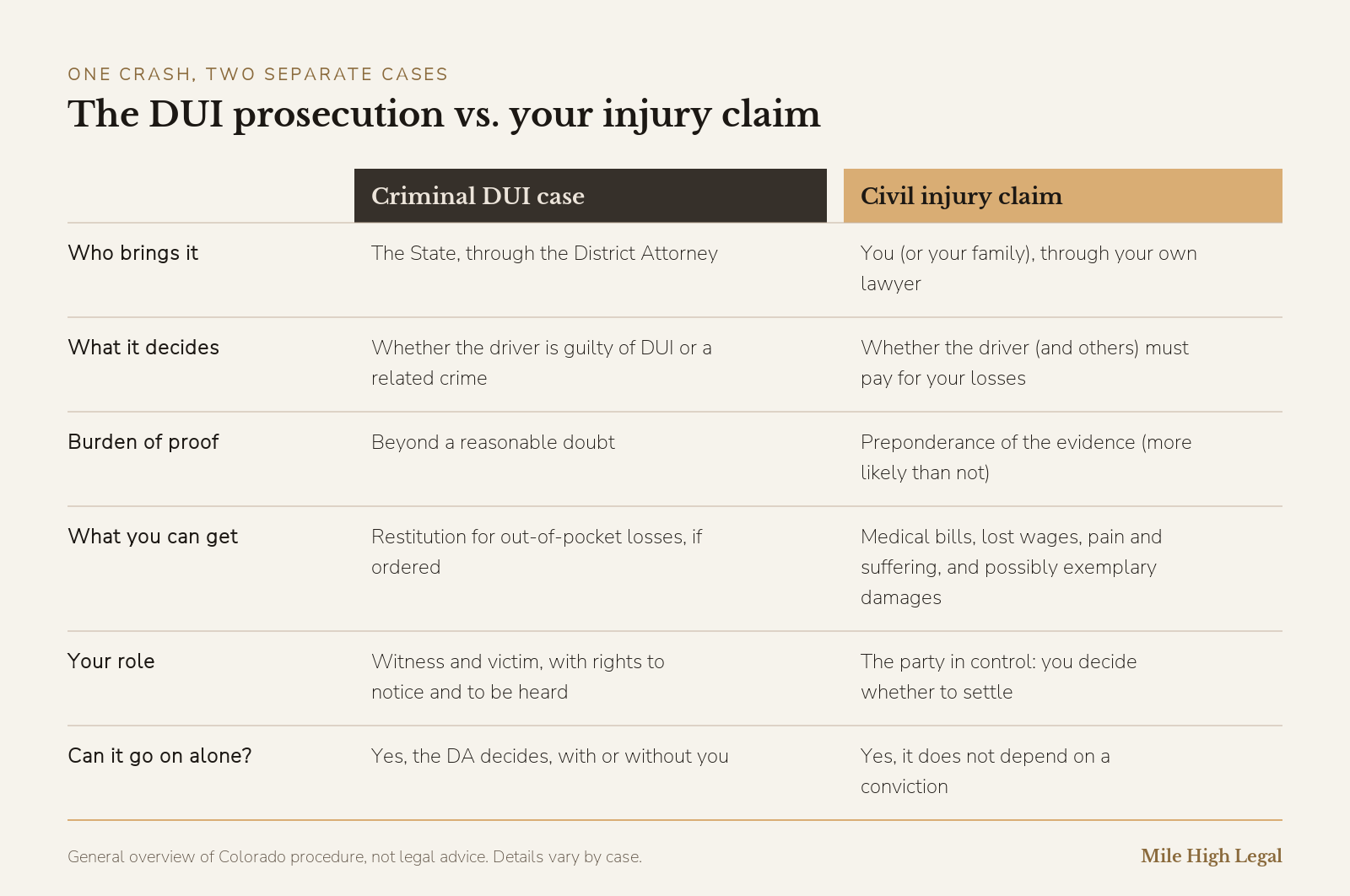
Yes. A drunk driving crash usually creates two completely separate cases. The criminal DUI case is brought by the State through the District Attorney, and its purpose is to decide whether the driver committed a crime and what punishment fits. Your injury claim is a civil case that you control, and its purpose is to make the driver (and anyone else responsible) pay for what the crash cost you. The criminal case doesn’t pay your medical bills or compensate your pain. The two cases run on different timelines, with different burdens of proof, and one doesn’t have to finish before the other begins. You can pursue your civil claim whether the driver pleads guilty, goes to trial, or is never charged at all.
Do you have to wait for the DUI case to finish?
No, but the timing is strategic. Criminal DUI cases in Colorado can take months to resolve, and the driver’s defense lawyer will often advise them not to say anything in a civil case that could hurt them in the criminal one. Sometimes it makes sense to open the insurance claim right away and let the criminal case finish before filing a lawsuit, because the criminal case often produces evidence (chemical test results, officer reports, body-cam video) that makes liability much easier to prove. Other times, waiting risks losing evidence or running into your filing deadline. The point is that it’s a decision, not a requirement, and it should be made deliberately.
Can the DUI conviction be used in your injury case?
Usually not directly, which surprises a lot of people. Colorado law says a record of conviction for a violation of the state’s traffic code, which is where DUI lives, is not admissible as evidence in a civil action (C.R.S. § 42-4-1713). So the conviction itself generally won’t be shown to the jury in your injury case. That rule covers traffic-code offenses; it does not, by its terms, reach criminal-code charges like vehicular assault or vehicular homicide. Either way, what really carries over is the underlying evidence: the blood or breath result, the officer’s observations and testimony, body-cam footage, witness statements, and anything the driver said at the scene. Because we defend DUI cases, we know where the weak points in that evidence tend to be, which also tells us how to make it hold up in a civil case.
What Damages Can You Recover After a Drunk Driving Accident in Colorado?
You can recover the same categories of compensation as in any Colorado car accident claim, and in some cases more. Economic damages cover the losses that come with a receipt: past and future medical care, lost wages and reduced earning capacity, and property damage. Noneconomic damages cover pain, emotional distress, and loss of enjoyment of life; Colorado caps these, and the cap was raised to $1.5 million for cases filed in 2025 and for claims that arise on or after January 1, 2025. Physical impairment and disfigurement are treated as their own category. What’s different about a drunk driving case is a possible fourth layer: exemplary damages, which exist to punish the driver rather than compensate you. Our guide to pain and suffering damages in Colorado walks through how the noneconomic piece gets valued.
What Are Exemplary Damages, and When Does Colorado Allow Them?
Exemplary damages are what most states call punitive damages. Under C.R.S. § 13-21-102, a Colorado jury may award them when the injury was “attended by circumstances of fraud, malice, or willful and wanton conduct.” The statute defines willful and wanton conduct as conduct “purposefully committed which the actor must have realized as dangerous, done heedlessly and recklessly, without regard to consequences, or of the rights and safety of others.” Choosing to drive after drinking can fit that definition. In White v. Hansen (1992), a Colorado jury found that a driver’s decision to drive after drinking was willful and wanton and awarded exemplary damages. The Colorado Supreme Court agreed exemplary damages may be awarded when the injured person wins the underlying claim, but it vacated that award because the jury had found the injured pedestrian 50% at fault, which barred any recovery. Two lessons: intoxication alone doesn’t guarantee exemplary damages, and they only exist if you win the case itself.
Can you ask for exemplary damages right away?
Not in your first complaint. Colorado law says a claim for exemplary damages can’t be included in the initial complaint. It can be added later by amending the complaint, but only after both sides exchange initial disclosures and you show the court prima facie proof of a triable issue (C.R.S. § 13-21-102(1.5)). In practice, that means the evidence of impairment needs to be gathered and organized early so the motion to amend is ready when the time comes. Exemplary damages also generally aren’t available in arbitration proceedings, which matters for some insurance claims.
How much can exemplary damages be? A worked example
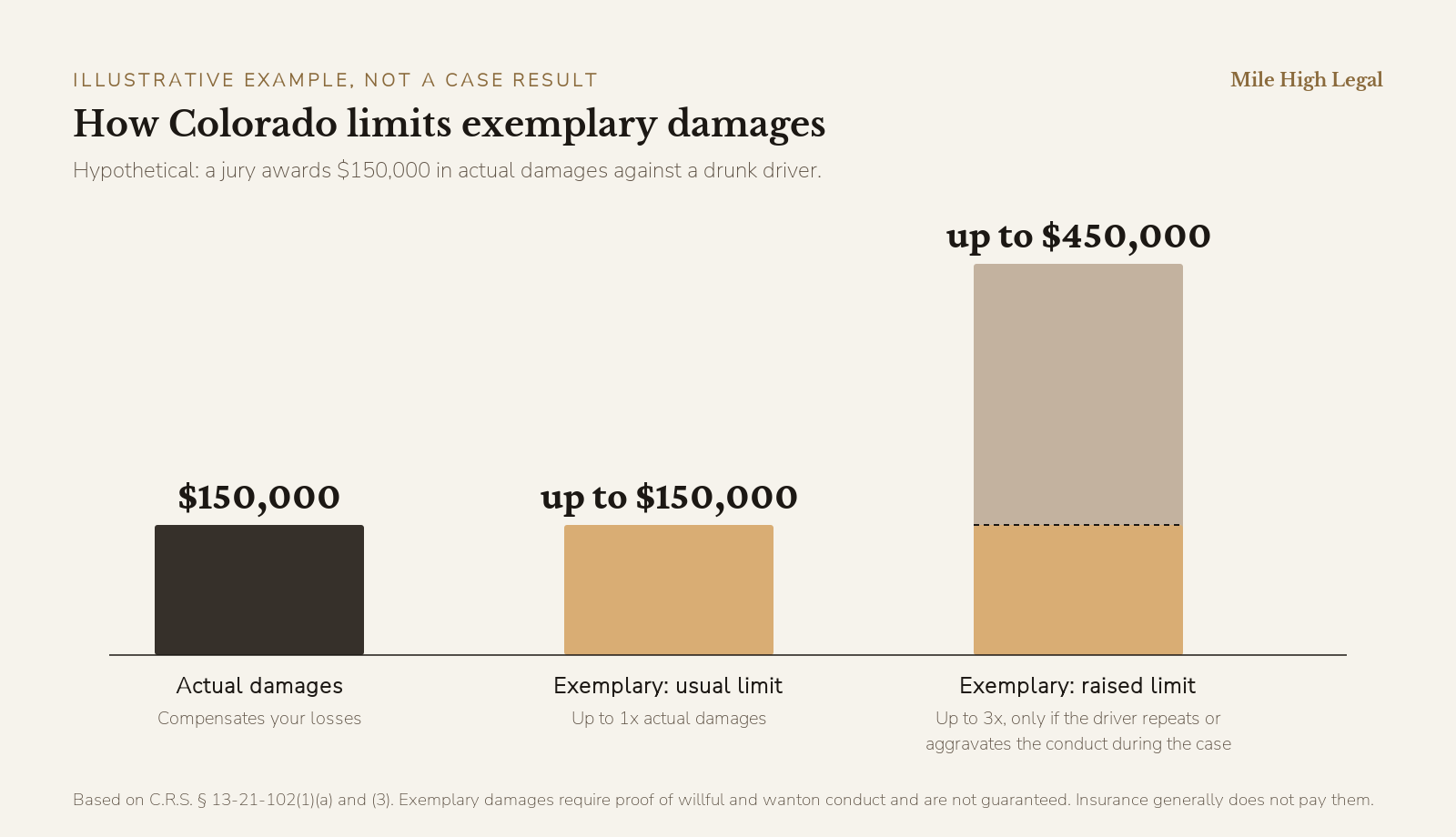
Colorado limits exemplary damages to an amount equal to your actual damages. A court can raise that to as much as three times actual damages, but only if the defendant repeats the conduct or aggravates your damages while the case is pending (C.R.S. § 13-21-102(1)(a), (3)). The court can also reduce exemplary damages in some circumstances.
Here’s a hypothetical, simplified to show the mechanics. It is not a case result or a prediction:
- Medical bills: $40,000
- Lost wages: $20,000
- Pain, suffering, and loss of enjoyment: $90,000
- Actual damages total: $150,000
- Exemplary damages, if the jury finds willful and wanton conduct: up to $150,000 (1x)
- Possible total: up to $300,000
- If the driver kept driving drunk while the case was pending and the court increased the award: exemplary damages up to $450,000 (3x)
Will the drunk driver’s insurance pay exemplary damages?
Generally, no. The Colorado Supreme Court has held that Colorado public policy prohibits insurance coverage for punitive damages (Lira v. Shelter Insurance Co., 1996). That means exemplary damages usually come out of the driver’s own pocket, and collecting them depends on what the driver actually has. That doesn’t make the claim pointless. A credible exemplary damages claim puts the driver personally at risk, which changes how seriously the defense and the insurer take settlement, and it changes how the full story gets told to a jury.
Who Else Can Be Held Responsible for a Drunk Driving Crash?
Sometimes the drunk driver isn’t the only one who owes you. Colorado’s dram shop law can make a bar, restaurant, or liquor store liable if it willfully and knowingly sold or served alcohol to someone who was visibly intoxicated or under 21. Those claims are capped at $150,000 (adjusted periodically for inflation) and must be filed within one year of the sale or service, far sooner than the usual car accident deadline (see our guide to dram shop liability in Colorado). A social host can be liable only if they knowingly served alcohol to someone under 21, or knowingly gave an underage person a place to drink, under the same cap and one-year deadline. A vehicle owner who lent the car to someone they knew was impaired, or an employer whose employee was driving on the job, may also be responsible. These claims matter most when the driver’s own insurance is small.
What if the Drunk Driver Has Little or No Insurance?
This is common, and it’s often the biggest practical problem in these cases. Drivers with prior DUIs may carry only state-minimum coverage, or none at all. Your own policy may fill the gap: uninsured and underinsured motorist (UM/UIM) coverage pays when the at-fault driver can’t. Medical payments (MedPay) coverage on your policy can help with immediate bills regardless of fault. Colorado’s crime victim compensation program may also cover some out-of-pocket losses for victims of DUI crashes, with award limits set by statute and local board policy. Read more about uninsured and underinsured motorist claims.
How Does Criminal Restitution Fit With Your Injury Claim?
If the driver is convicted, the criminal court can order restitution, which is repayment of certain out-of-pocket losses the crime caused, such as medical bills and lost wages. Restitution is useful, but it’s limited. It typically doesn’t include pain and suffering, it’s paid on the driver’s timeline, and amounts you receive may be credited against a later civil judgment so you aren’t paid twice for the same loss. If the driver is charged with a crime covered by Colorado’s Victim Rights Act, such as vehicular assault or vehicular homicide, you have rights to be informed about the case and to be heard at sentencing. A misdemeanor DUI charge on its own isn’t on that list, but it’s still worth asking the DA’s office to keep you updated.
Does Your Own Fault Matter if the Other Driver Was Drunk?
It can. Colorado uses modified comparative negligence: your compensation can be reduced by your percentage of fault, and you recover nothing if you’re found 50% or more responsible. The Colorado Supreme Court held in White v. Hansen that a plaintiff’s own negligence can still be compared against a drunk driver’s willful and wanton conduct. In that case, the jury split fault 50/50 between a pedestrian walking in the roadway at night and a driver who had been drinking, and the pedestrian recovered nothing, including the exemplary damages the jury had awarded. So if the insurer argues you were speeding or not wearing a seat belt, take it seriously. In most drunk driving crashes the fault picture is lopsided, but the defense will still try to shift some of it to you. Our guide to comparative negligence in Colorado car accidents explains the math.
How Long Do You Have to File a Drunk Driving Injury Claim in Colorado?
Colorado’s statute of limitations for most motor vehicle injury claims is three years from the date of the crash, and wrongful death claims have a different, shorter deadline. Claims involving a government vehicle require a written notice of claim much sooner. Don’t let the length of the criminal case lull you into waiting. The criminal case doesn’t pause your civil deadline, and evidence like bar surveillance video may be gone long before then. See What is the statute of limitations for a car accident claim in Colorado?
If Someone You Love Was Killed by a Drunk Driver
Nothing in a legal process can answer that loss. What the law can do is hold the driver accountable financially and give your family resources to get through what comes next. Colorado’s wrongful death statute limits who can bring a claim and when, and the rules are different in the first year after a death. If you’re in that situation, please read Who can file a wrongful death lawsuit after a Colorado car accident? and call us when you’re ready.
When Should You Talk to a Lawyer After Being Hit by a Drunk Driver?
As early as you can, mainly because of evidence. The criminal case will collect some of what you need, but not all of it, and not on your timeline. A lawyer can request the crash report and chemical test results, send preservation letters to bars and businesses, track the DUI case so you know when a plea or conviction happens, check for every available insurance policy (including your own UM/UIM), and build the record needed to seek exemplary damages later. If you were seriously hurt, if the driver was uninsured, or if someone else served the driver alcohol, it’s worth a conversation. Learn more on our Colorado car accident page.
Talk to Mile High Legal About Your Drunk Driving Accident Claim
You didn’t choose any of this. The person who drove impaired did, and they should be the one who answers for it. At Mile High Legal, we handle Colorado drunk driving accident claims on contingency: you pay nothing upfront, and nothing at all unless we recover money for you. Call (720) 853-5779 or contact us online for a free, confidential consultation.
This article is general information about Colorado law, not legal advice for your situation. Every case depends on its own facts, and past results do not guarantee a similar outcome. Reading this article does not create an attorney-client relationship.
Sources
- Colorado Department of Transportation, Impaired Driving (2025 fatality and enforcement data)
- KOAA News5, El Paso County had highest number of impaired traffic deaths in Colorado in 2025 (Feb. 12, 2026)
- The Colorado Sun, Colorado traffic deaths rose in 2025 (Jan. 23, 2026)
- C.R.S. § 13-21-102, Exemplary damages
- C.R.S. § 42-4-1713, conviction record inadmissible in civil action; C.R.S. § 44-3-801, dram shop and social host liability; HB 24-1472 (2024), noneconomic damages cap
- White v. Hansen, 837 P.2d 1229 (Colo. 1992); Lira v. Shelter Insurance Co., 913 P.2d 514 (Colo. 1996)