By Grant Grosgebauer, Mile High Legal · Last reviewed November 22, 2026
Being rear-ended feels like the simplest kind of crash. You were stopped or slowing, someone hit you from behind, and the fault seems obvious. Then the other driver’s insurer calls, asks for a recorded statement, suggests you “stopped short,” and offers a number that barely covers the first few weeks of treatment. Neck and back pain that seemed minor at the scene can get worse over the following days, and the bills keep arriving. This guide explains how Colorado law approaches fault in rear-end crashes, what the rear driver may argue to shift blame, how shared fault changes what you can recover, and what to do in the first days after the crash to protect your claim.
Who is at fault in a rear-end collision in Colorado?
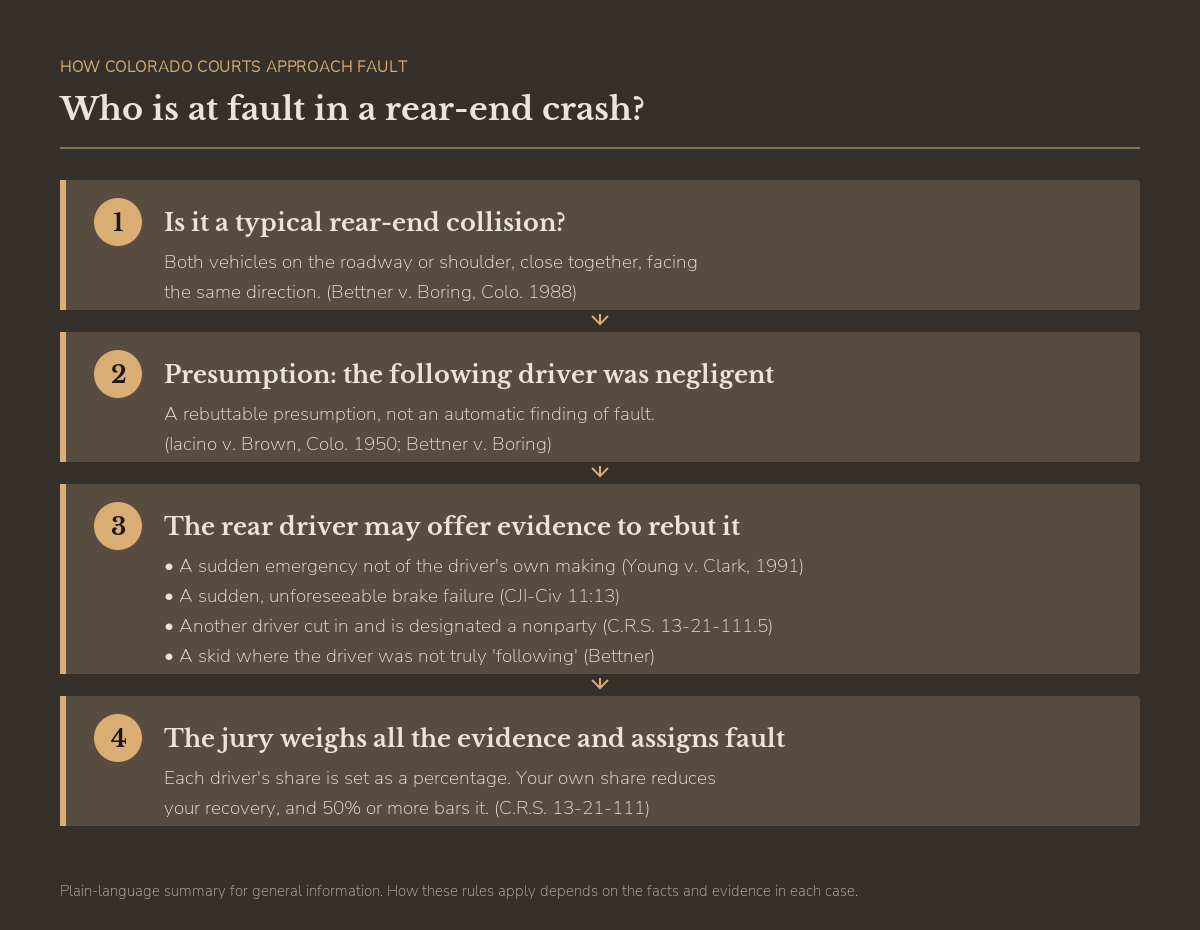
In a typical rear-end crash, Colorado law starts from a presumption that the following driver was negligent. The rule traces to Iacino v. Brown, 121 Colo. 450, 217 P.2d 266 (1950), and the Colorado Supreme Court restated it in Bettner v. Boring, 764 P.2d 829 (Colo. 1988): “The general rule in cases of rear-end collisions is that the driver of the car that follows and overtakes the car in front is presumed to have been negligent.” The presumption is rebuttable, which means the rear driver can offer evidence that their own negligence did not cause the crash. Bettner also limited it to collisions where both vehicles were on the roadway or shoulder, in relatively close proximity, and facing the same direction. Separately, Colorado’s following-too-closely statute, C.R.S. 42-4-1008(1), requires drivers to keep a distance that is “reasonable and prudent” for the speed, traffic, and road conditions.
Does the rear driver always pay?
No. The presumption shifts the starting point, but it does not decide the case on its own. In Bettner, the defendant’s pickup spun out on an icy stretch of I-25 near Pueblo and slid into a car that had already pulled off the highway into a field. The Colorado Supreme Court upheld the trial judge’s refusal to give the rear-end presumption instruction, because the defendant was not a “following motorist.” The court said the outer limits of the rule are decided case by case and, quoting an earlier Missouri decision, cautioned against using it “except where the facts come strictly within the pattern of the typical rear-end collision situation.” Even when the presumption applies, the rear driver can try to rebut it, for example with evidence that the lead driver did something unexpected, that a third driver set off the chain of events, that the brakes failed suddenly and unforeseeably, or that a true emergency left no time to react. The jury then weighs all of the evidence.
How the presumption is presented to a jury is also not fully settled. Colorado’s pattern jury instruction on it (CJI-Civ 11:12) was approved by the Court of Appeals in 2015, but the instruction committee’s note says it appears inconsistent with Colorado Supreme Court decisions holding that a rebutted presumption drops out and leaves only a permissible inference. The Supreme Court has not yet decided whether those decisions apply to rear-end cases.
What is the “sudden emergency” defense in a rear-end crash?
The sudden emergency doctrine recognizes that a driver confronted with a sudden, unexpected event is judged by what a reasonably careful person would do in that same emergency. The Colorado Supreme Court approved its use in a rear-end case, Young v. Clark, 814 P.2d 364 (Colo. 1991). That crash happened on Colorado Highway 36, where construction had slowed traffic. An unidentified driver four or five cars ahead pulled into the right lane and then swerved back, forcing the cars behind to brake. The defendant, who had looked over her shoulder to change lanes, could not stop in time and hit the plaintiff’s car. The court held the trial judge properly gave the sudden emergency instruction, and the jury found the defendant was not negligent. The court also stressed the doctrine’s limits: it does not lower the standard of care, it applies only to an emergency not of the person’s own making, and it is not available to a driver who is obviously negligent. Whether a driver who was following too closely or not watching the road helped create the emergency is a question for the jury. No rear-end presumption instruction was requested in Young, so the court did not address how the two rules interact.
Can I be partly at fault if I was rear-ended?
Yes, it is possible. Insurers sometimes argue that the lead driver stopped abruptly for no reason, had brake lights that were out, changed lanes directly in front of the other car, or was reversing. Colorado’s pattern jury instructions note that a jury could find an abrupt, unwarranted stop by the lead driver to be contributory negligence, citing Gaulin v. Templin, 162 Colo. 55, 424 P.2d 377 (1967). If a jury finds you were partly at fault, Colorado’s comparative negligence statute, C.R.S. 13-21-111, reduces your damages in proportion to your share. If your negligence is equal to or greater than the negligence of the driver you are suing, you recover nothing from that driver. Evidence that you were stopped or slowing in your own lane can be strong, but it is worth taking these arguments seriously from the start, because an insurer can use them to justify a low offer. Our guide to comparative negligence in Colorado car accidents explains the rule in more detail.
How does shared fault change what I recover? A worked example
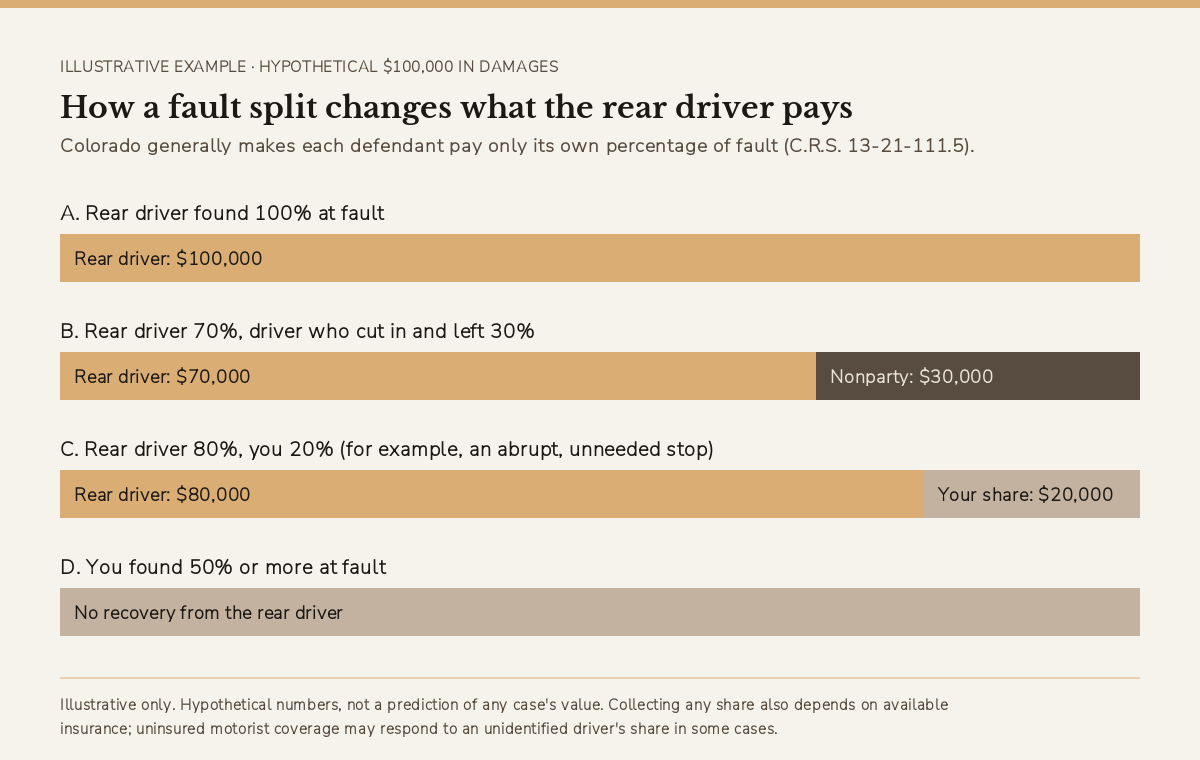
Here is a hypothetical. Suppose your total damages (medical bills, lost wages, and noneconomic losses) come to $100,000.
- The rear driver is found 100% at fault. You can recover the full $100,000 from that driver, subject to the insurance and assets available.
- The rear driver is 70% at fault and a driver who cut in and drove off is 30% at fault. Colorado generally makes each defendant pay only its own percentage of fault (C.R.S. 13-21-111.5), so the rear driver owes $70,000. A defendant can ask the jury to assign fault to someone who is not a party by filing a nonparty designation, which is generally due within 90 days after the lawsuit is filed. The $30,000 share assigned to the driver who left may be difficult to collect unless another source, such as your own uninsured motorist coverage, applies.
- The rear driver is 80% at fault and you are found 20% at fault for an abrupt, unneeded stop. Your recovery is reduced by 20%, to $80,000.
- You are found 50% or more at fault (equal to or greater than the rear driver’s share). You recover nothing from the rear driver.
The example in Young v. Clark shows why the second scenario matters: the defendant there designated the unidentified driver who swerved as a nonparty at fault, and the jury ultimately found the defendant was not negligent at all.
Who is at fault in a chain-reaction (multi-car) rear-end crash?
Pileups are harder because each impact can have a different cause. In a three-car crash, the last driver may have pushed the middle car into the first one, or the middle driver may have hit the first car before being struck from behind. Fault can be split among several drivers, and each one’s insurer will point at the others. The order of impacts matters, and it can be reconstructed from vehicle damage, the location of debris, witness accounts, dashcam or traffic video, and data from the vehicles’ event data recorders. If you were in the middle car, you may have a claim against the driver behind you and still face questions about whether you were following the first car too closely. Because each defendant generally pays only its own share, identifying every responsible driver early is important.
How often do rear-end crashes happen in Colorado?
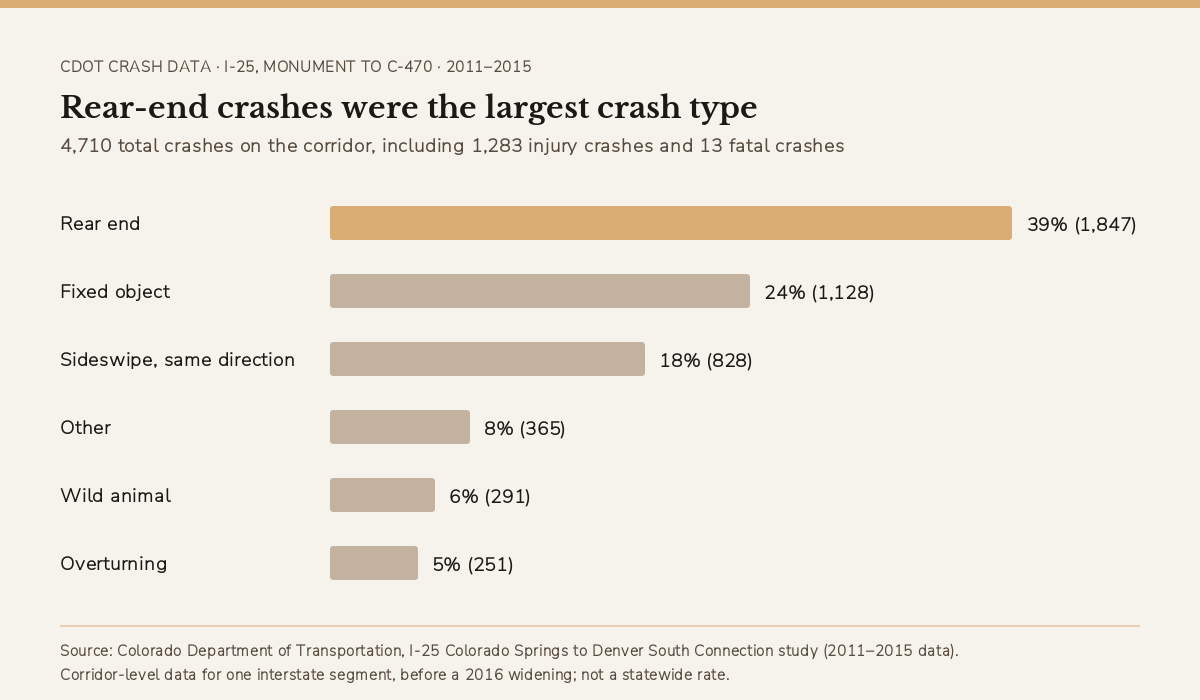
Statewide crash-type percentages are not published in an easy-to-cite form, but CDOT corridor studies show how often they occur on some busy highways. In CDOT’s safety review for its I-25 Colorado Springs to Denver South Connection study, covering I-25 between Monument and C-470, rear-end crashes were the single largest crash type from 2011 to 2015: 1,847 of 4,710 crashes, or 39%. That corridor recorded 1,283 injury crashes and 13 fatal crashes over the same period. CDOT noted that rear-end and sideswipe crashes “indicate turbulence” in traffic and occur more often where the number of lanes increases or decreases. The figures predate a 2016 widening that CDOT said improved safety on part of the corridor. Statewide, CDOT’s 2025 Strategic Highway Safety Plan counted 1,040 fatalities and serious injuries tied to distracted driving from 2021 to 2023.
What injuries are linked to rear-end collisions?
When a car is pushed forward from behind, the occupants’ bodies move with the seat while the head lags and then snaps forward. That motion can strain the soft tissues of the neck and upper back, the injury people call whiplash. Rear-end crashes can also cause back injuries, concussions when the head strikes the headrest or another surface, shoulder and wrist injuries from bracing against the steering wheel, and, at higher speeds, more serious spinal or brain injuries. Symptoms do not always appear right away, and adrenaline can mask pain at the scene. Getting evaluated promptly protects your health and creates a medical record that links your symptoms to the crash. Our guides to whiplash and neck or back injury claims, traumatic brain injury claims, and spinal cord injury claims cover those injuries in more depth.
Why do insurers fight “low-impact” rear-end claims?
When a rear-end crash leaves only a small dent, insurers sometimes argue that a minor-looking impact could not have caused a real injury. Vehicle damage is one piece of evidence, but bumpers are designed to absorb impact and spring back, so a modest repair estimate does not by itself show what happened to the people inside. These claims tend to turn on medical documentation: when symptoms began, what the treating providers found, whether you had prior neck or back problems, and whether your treatment was consistent. Colorado’s pattern jury instructions include an instruction on aggravation of a pre-existing condition (CJI-Civ 6:8), so a prior injury does not automatically defeat a claim. Gaps in treatment and casual comments to an adjuster are frequent targets for the defense in these cases.
Does the other driver’s traffic ticket prove fault?
Not in the injury case. The officer may cite the rear driver for following too closely, which is a class A traffic infraction under C.R.S. 42-4-1008(4). But C.R.S. 42-4-1713 provides that, with limited exceptions, “no record of the conviction of any person for any violation of this article shall be admissible as evidence in any court in any civil action.” So even if the other driver pays the ticket, that conviction generally cannot be used to prove fault in your injury lawsuit. The facts behind the ticket still matter, though. The officer’s observations, measurements, and witness statements in the crash report, along with photos and video, are how fault is proven. If the rear driver was on a phone, Colorado’s hands-free law may also be relevant. Under SB24-065, which took effect January 1, 2025, drivers 18 and older generally may not use a mobile electronic device while driving except through a hands-free accessory, with exceptions such as emergencies.
What evidence should I gather after a rear-end crash?
Evidence in rear-end cases can disappear quickly, especially video. If you are able, gather or request the following:
- Photos of both vehicles (including the other car’s front end), the lanes, skid marks, debris, traffic signals, and the weather and road surface.
- The crash report number and the name of the investigating agency, so you can request the report.
- Witness names and phone numbers, especially drivers who were behind the crash.
- Dashcam footage from your car or a witness’s car, saved right away before it records over.
- Nearby video from businesses, buses, or traffic cameras. Some systems overwrite footage within days or weeks.
- Vehicle data. Some vehicles store speed and braking data in an event data recorder. Ask that neither car be scrapped or repaired until preservation is addressed.
- Medical records from your first visit forward, plus a short daily log of your symptoms and missed work.
- Repair estimates and receipts, including rental car costs. A diminished value claim may also be available for your vehicle.
Should I talk to the other driver’s insurance company?
You may need to give the at-fault driver’s insurer basic information to open a property damage claim, but be careful with a recorded statement about your injuries. Adjusters may ask whether you “stopped suddenly,” whether you are “feeling better,” or whether you had prior neck pain, and short answers given days after a crash can be quoted back later. You are generally not required to give the other driver’s insurer a recorded statement. Before you do, it helps to know what your medical providers have found and what the other side’s theory of fault is. See should I give a recorded statement to an insurance adjuster?
What if the driver who rear-ended me has no insurance or too little?
Colorado requires drivers to carry liability insurance, but some do not, and some carry limits that are low compared to the cost of a serious injury. If the at-fault driver is uninsured or underinsured, or drove away after the crash, your own uninsured/underinsured motorist (UM/UIM) coverage may help pay for your injuries. These claims are made against your own insurer, which can dispute fault, causation, or the value of your injuries like any other insurer. Learn more about uninsured and underinsured motorist claims. If the rear driver was impaired, see hit by a drunk driver in Colorado.
How long do I have to file a rear-end accident claim in Colorado?
For a car-crash injury claim against a private driver, Colorado generally allows three years after the claim accrues to file a lawsuit (C.R.S. 13-80-101(1)(n)). Different rules can apply in other situations. If the vehicle that hit you was a city bus, a government truck, or another public vehicle, a written notice under the Colorado Governmental Immunity Act must generally be filed within 182 days after discovering the injury (C.R.S. 24-10-109). That notice deadline is separate from, and earlier than, the deadline to file a lawsuit. See our guides on Colorado’s car accident statute of limitations and RTD and bus accident claims. In practice, waiting is risky for another reason: video and witness memories can be lost quickly.
How much is a rear-end accident claim worth?
There is no standard value, and “average settlement” figures online deserve skepticism. A rear-end claim’s value depends on the medical treatment you need now and in the future, lost income, how the injuries affect your daily life, how clearly the evidence shows fault, any comparative-fault reduction, and the insurance available. Noneconomic damages such as pain and suffering are subject to a statutory cap in Colorado; see pain and suffering damages in Colorado. If your health insurer paid for treatment, it may seek repayment from the settlement; see health insurance liens. Not wearing a seat belt can also affect certain damages; see the seat belt defense.
Hurt in a rear-end crash in Colorado?
Rear-end cases look simple from the outside, but the insurer’s playbook is predictable: question the impact, question the injury, and look for any way to put part of the blame on you. Mile High Legal represents people injured in car crashes across Colorado. We can help you preserve the video and vehicle data that settle fault, document your injuries properly, and push back on a lowball offer. Contact us to talk about your case, or read more about Colorado car accident claims.
Data sources: Colorado Department of Transportation, I-25 Colorado Springs to Denver South Connection study: crash types, Monument to C-470 (2011–2015); Colorado Department of Transportation, 2025 Strategic Highway Safety Plan, Chapter 2. Colorado Supreme Court Model Civil Jury Instructions, Chapter 11 (Motor Vehicles). Cases: Iacino v. Brown, 121 Colo. 450, 217 P.2d 266 (1950); Bettner v. Boring, 764 P.2d 829 (Colo. 1988); Young v. Clark, 814 P.2d 364 (Colo. 1991); Gaulin v. Templin, 162 Colo. 55, 424 P.2d 377 (1967). Colorado General Assembly, SB24-065. Statutes quoted from the Colorado Revised Statutes as published by the Colorado General Assembly.
This page is general information, not legal or medical advice, and does not create an attorney-client relationship. Past results do not guarantee future outcomes.